Blog
What Is Thai SELECT? Inside Thailand's Restaurant Certification Program
Thai SELECT is the Thai government's official quality mark for authentic Thai restaurants abroad, now covering 1,419 restaurants in 70 countries. Here's how it works and what the mark actually guarantees.
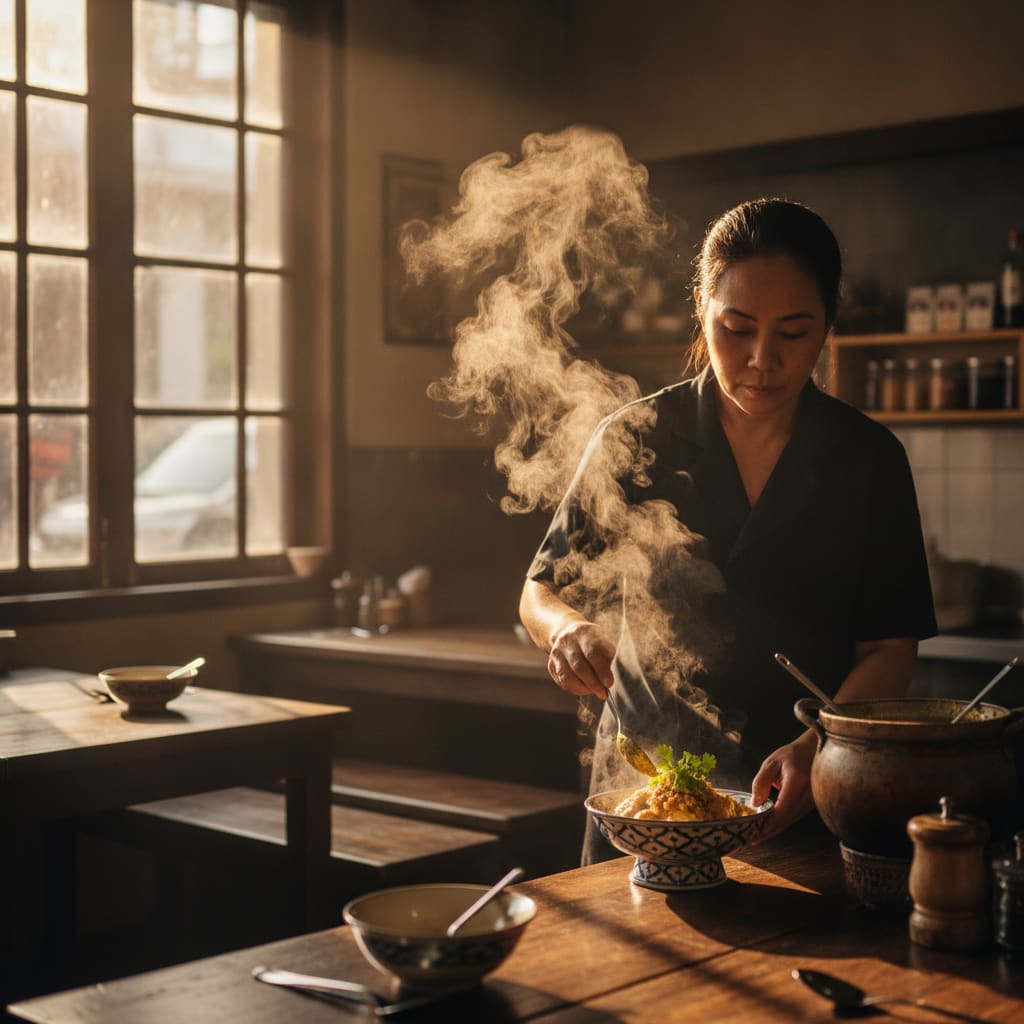
Walk into a Thai restaurant almost anywhere in the world and you might spot a small gold mark near the door or on the menu: an orchid, or a stamp reading "Thai SELECT." It looks decorative, but it's actually a government credential. The Thai Ministry of Commerce hands it out, and it exists for a specific reason: Thailand exported its cuisine faster than it could guarantee its quality, and eventually decided to do something about it.
The problem Thai SELECT was built to solve
In 2002, Thailand's government launched a campaign that would later be nicknamed "Kitchen of the World." The goal was blunt: get more Thai restaurants opened abroad, fast, as a way of projecting Thai culture and driving exports of Thai ingredients and products. It worked almost too well. Within a decade, the number of Thai restaurants worldwide grew from roughly 5,500 to more than 15,000, according to figures widely cited in gastrodiplomacy research, to the point where pad thai became about as easy to find in a mid-size Western city as pizza.
The catch: a government can subsidize the number of Thai restaurants opening abroad, but it can't directly control what happens in each of those kitchens. Many of the new restaurants were run by non-Thai owners, staffed by non-Thai cooks, and served food that had drifted a long way from anything a diner in Bangkok would recognize. Thailand's government worried, reasonably, that a flood of mediocre or inauthentic "Thai" food would dilute the reputation it was trying to build.
Thai SELECT was the fix. First introduced in 2006 by the Ministry of Commerce, it's a certification mark, not a marketing campaign. Instead of paying for more restaurants to open, it asks existing restaurants to prove they meet a standard, and rewards the ones that do with a mark diners can actually recognize.
Who runs it, and how a restaurant gets certified
Thai SELECT is administered by the Department of International Trade Promotion (DITP), under the Ministry of Commerce. For restaurants outside Thailand, certification isn't automatic or self-declared. To qualify, a restaurant generally needs to:
- Have been operating for at least six months
- Seat at least 10 people
- Serve a menu that's at least 70% authentically Thai dishes
- Be led by a Thai head chef
- Meet hygiene and presentation standards consistent with "Thainess" in atmosphere and service
Certification is valid for three years, after which a restaurant has to requalify. It's not a one-time plaque you hang up and forget about.
As of May 2026, DITP reports 1,419 Thai restaurants abroad have passed certification, spread across 70 countries. The program has also rolled out a refreshed "Orchid Star" evaluation tier, part of what DITP is calling the Thai SELECT Restaurant Capacity-Building and Networking Program, aimed at raising the bar further rather than just expanding the count. DITP Director-General Sunanta Kangvalkulkij has described the mark as covering authentic Thai taste, quality ingredient sourcing, correct traditional cooking technique, and service and atmosphere that reflect Thai culture, calling it a mechanism for building consumer confidence and advancing Thai soft power at the same time (nationthailand.com).
What the mark does and doesn't guarantee
It's worth being precise about what Thai SELECT actually certifies, because it's easy to over-read it. It's a quality and authenticity mark focused on ingredients, technique, and menu composition, not a food-safety inspection in the way a health department grade is, and not a taste guarantee in the way a Michelin star aims to be. A Thai SELECT restaurant has demonstrated, to Thai government evaluators, that it's cooking real Thai food with a real Thai chef and a menu that isn't mostly fusion or Americanized dishes wearing a Thai name.
That's genuinely useful information for a diner who can't otherwise tell the difference between a restaurant run by someone who trained in Chiang Mai and one that's adapted its menu heavily for local palates. But it's a floor, not a ranking. Two Thai SELECT restaurants can still cook very differently from each other, and plenty of excellent Thai restaurants outside the program simply haven't applied, often because the six-months-and-ten-seats bar is easy to clear but the paperwork and renewal cycle isn't worth it for a small operator.
Why this matters beyond Thailand
Thai SELECT is one of the more mature examples of what researchers call gastrodiplomacy: a government using food as a soft-power tool, the same instinct behind cultural exports like film or music, aimed at the stomach instead. It's also one of the more measurable ones. Most countries that try culinary diplomacy end up measuring success in restaurant openings or press coverage. Thailand built an actual quality-control layer into its version, which is part of why the program has lasted two decades while a lot of gastrodiplomacy campaigns fade after their initial funding cycle.
If you're looking for a Thai restaurant and want a starting signal for authenticity, the Thai SELECT mark is a reasonable one to search for. It won't tell you if you'll personally love the food, but it does tell you the restaurant was built, and is still being run, the way the Thai government's own evaluators expect real Thai food to be made.
This is the first post in a series looking at government culinary diplomacy programs and the restaurants carrying them forward; the next covers how other countries, from South Korea to Taiwan, have run their own versions of the same idea.