Blog
How Taiwan Uses Night Markets and Bubble Tea as Diplomacy
Taiwan's £20 million "All in Good Taste" campaign turned bubble tea, oyster omelette, and night-market culture into a diplomatic tool for a country with limited formal international recognition.
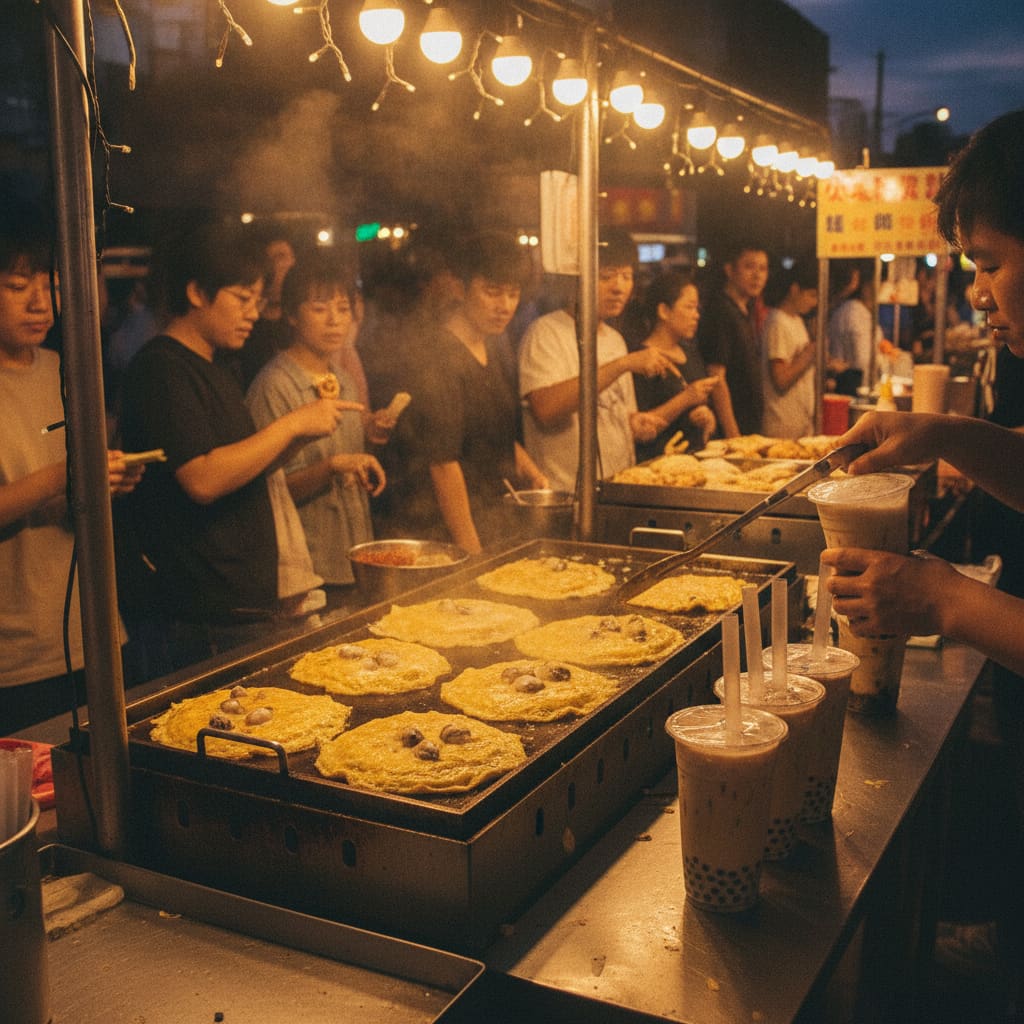
Most countries running gastrodiplomacy programs are trying to solve a marketing problem: how do we get more people to try our food? Taiwan's version, launched in 2010, was solving something harder. Because Taiwan has limited formal diplomatic recognition in many parts of the world, the usual tools of international relations, embassies, treaties, state visits, are often unavailable to it. Food became a workaround.
"All in Good Taste": the pitch
Taiwan's Ministry of Economic Affairs launched a £20 million campaign called "All in Good Taste: Savor the Flavors of Taiwan" in 2010. It sponsored chefs internationally, funded food festivals and cooking competitions, and built its identity around a handful of instantly exportable, visually distinct food items: bubble tea, oyster omelette, and the sprawling, chaotic energy of Taiwan's night markets themselves.
That choice of imagery wasn't accidental. Bubble tea in particular was already spreading organically before the campaign existed. Taiwan's government recognized a genuine grassroots export and put institutional weight behind accelerating it, rather than trying to invent interest in a dish from scratch, which is a harder and slower version of the same playbook.
Diplomacy without an embassy
The strategic logic here is worth spelling out, because it's different from Thailand's or Korea's version of the same idea. Thailand and Korea used gastrodiplomacy to add a cultural layer on top of existing diplomatic relationships and trade ties. Taiwan, in many countries, doesn't have that foundation to build on: it maintains formal diplomatic relations with a relatively small number of states, a direct consequence of its disputed international status.
Food diplomacy sidesteps that limitation almost entirely. A night market pop-up, a bubble tea shop, a Taiwanese restaurant winning local press coverage, none of it requires the host country to take an official diplomatic position on Taiwan. It builds public familiarity and goodwill through commerce and culture instead of through the state department channels that are politically complicated or simply closed off. Researchers on Taiwan's foreign relations have specifically pointed to this as one of the country's few reliably available forms of soft power.
What it actually built
Beyond the sponsorships and festivals, the campaign leaned into tourism messaging as much as restaurant expansion: Taiwan's night markets aren't just a food category, they're a tourism product, an experience you have to travel to Taiwan itself to fully get, which ties the culinary campaign directly back to visitor numbers rather than only restaurant counts abroad. That's a subtly different model from Thailand's Thai SELECT, which is entirely focused on certifying restaurants that already exist outside the country.
What it means for diners
If you've noticed bubble tea shops multiplying in cities that had none a decade ago, or a Taiwanese breakfast spot doing brisk business next to more established Chinese and Japanese restaurants, you're seeing a campaign that's been running for over fifteen years now doing exactly what it was designed to do. Unlike Thai SELECT, there's no certification mark to look for here; Taiwan's approach was built on visibility and volume, not verification. The tradeoff is that quality and authenticity vary more restaurant to restaurant, since there's no formal quality gate the way there is with Thailand's system.
That's not necessarily a downside for diners. It just means the discovery burden shifts from "is this restaurant certified" to "does this restaurant look and feel like it's actually run by people with a real connection to Taiwanese food," the same judgment call diners have always had to make for cuisines without a formal government mark behind them.
Sources: Culinary diplomacy, Wikipedia.