Blog
Gastrodiplomacy 101: How Governments Turn Restaurants Into Soft Power
From Thailand's Global Thai program to South Korea's Kimchi Diplomacy and Taiwan's night-market campaigns, a growing list of governments treat restaurants abroad as instruments of foreign policy. Here's how the idea actually works.
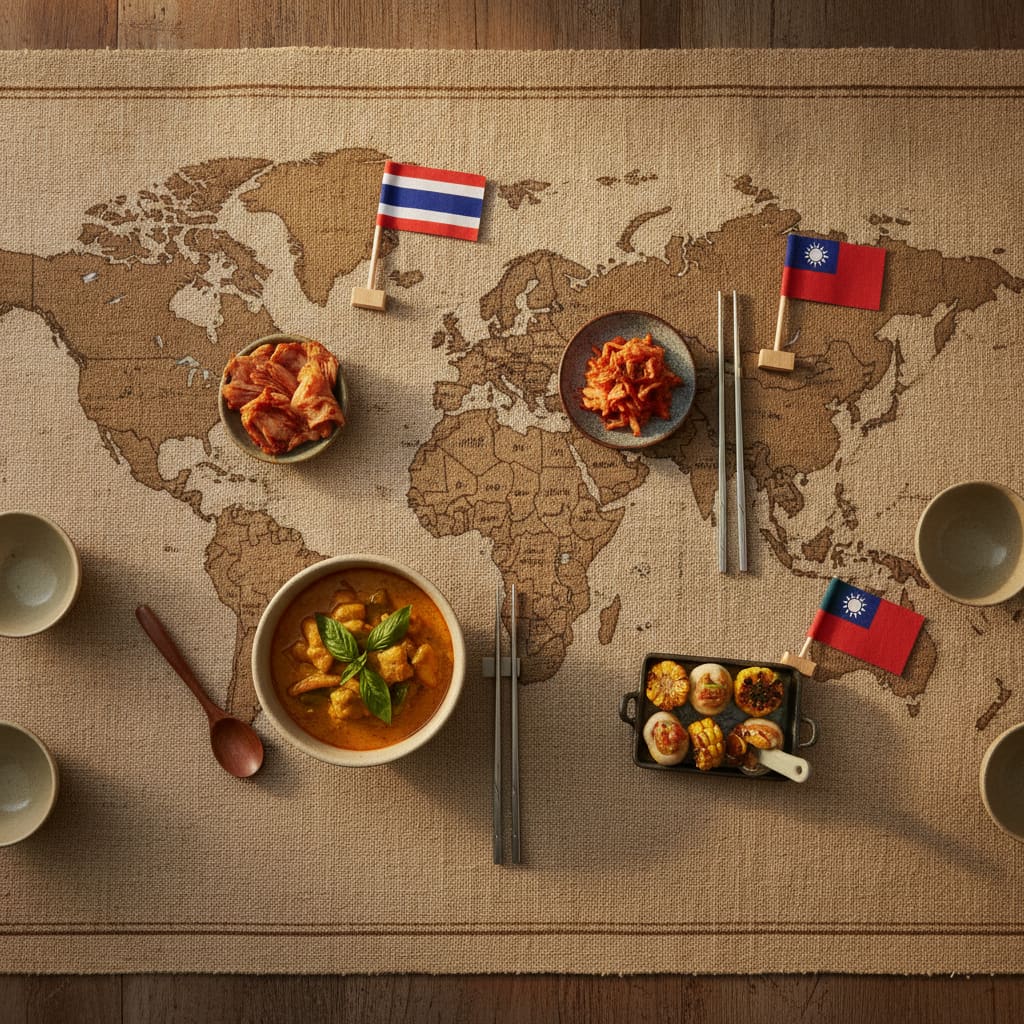
There's a term diplomats and food researchers use for a specific kind of government program: gastrodiplomacy. Also called culinary diplomacy or food diplomacy, it's a type of cultural diplomacy built on a simple premise, credited to diplomacy scholar Paul Rockower: the easiest way to win hearts and minds is through the stomach.
It sounds like a soundbite, but it describes something real and specific: national governments spending public money, sometimes tens of millions of dollars, to promote their cuisine abroad, on the theory that a country whose food you love is a country you're inclined to trust, visit, and buy from. This post is an overview of how the idea works and who's actually doing it. Later posts in this series will go deeper on individual programs and the restaurants carrying them out.
Thailand: the program that started the modern wave
Thailand is usually credited with running the first large-scale, deliberately branded gastrodiplomacy campaign. In 2002, its "Global Thai" initiative, later nicknamed "Kitchen of the World," set out to dramatically increase the number of Thai restaurants abroad. It worked: the global count went from around 5,500 to more than 15,000 restaurants within about a decade.
That success created a new problem, quality control, which is what led to the Thai SELECT certification mark: a follow-on program that verifies restaurants are actually cooking authentic Thai food rather than just using the name. We covered that program in detail in our previous post.
South Korea: "Kimchi Diplomacy"
In 2009, South Korea launched a $77 million program officially called "Korean Cuisine to the World," or Global Hansik, run by the country's Ministry of Food, Agriculture, Forestry and Fisheries. It picked up the nickname "Kimchi Diplomacy" internationally. The stated goals were ambitious: make Korean cuisine one of the world's top five most popular by some measures, and meaningfully grow the number of Korean restaurants abroad.
The program funded things a marketing campaign alone wouldn't: it helped establish the World Institute of Kimchi as a research body, pushed to get Korean cuisine taught in internationally recognized culinary schools, and ran a touring Korean food truck as a form of direct, low-friction outreach. It's frequently cited alongside Thailand's program as one of the two clearest examples of a government treating restaurant cuisine as a deliberate export product rather than an incidental one.
Taiwan: food as diplomacy without formal diplomatic ties
Taiwan's version, launched in 2010 by its Ministry of Economic Affairs, was called "All in Good Taste: Savor the Flavors of Taiwan" and carried a budget of around £20 million. It sponsored chefs, ran international food festivals and competitions, and leaned into instantly recognizable elements of Taiwanese food culture: bubble tea, oyster omelette, and the sprawling night-market format itself.
Taiwan's case is a useful illustration of why gastrodiplomacy appeals to governments beyond simple tourism marketing. Because Taiwan has limited formal diplomatic recognition in many countries, cultural and culinary programs give it a way to build goodwill and international visibility that doesn't require the kind of official government-to-government relationship that traditional diplomacy does.
The United States: chefs as informal ambassadors
The US approach looks different because it isn't built around a single national cuisine to export. In September 2012, the State Department officially launched the Culinary Diplomacy Partnership Initiative, recruiting more than 80 chefs into what became known as the American Chef Corps, including White House Executive Chef Cristeta Comerford and high-profile names like José Andrés and Rick Bayless. Rather than promoting one dish or region, the program uses chefs as informal cultural ambassadors at official functions and international events, representing the diversity of American food rather than a single culinary tradition.
Who else is doing this
Beyond the four above, official government-sponsored culinary diplomacy programs have been documented in Cambodia, Indonesia, Israel, Japan, Lebanon, Malaysia, the Nordic countries, Peru, Singapore, and Switzerland, among others, each shaped by that country's specific diplomatic goals. Singapore, for instance, has used its embassies directly, hosting tastings of dishes like Katong laksa for local organizations abroad as a lower-budget, relationship-first version of the same idea, rather than a large centrally funded campaign.
Why this matters if you're just looking for dinner
None of this changes what's on the plate, but it does explain something diners often notice without quite naming it: why certain cuisines suddenly seem to be everywhere, opening in cities where they had little presence a decade earlier. It's rarely organic market demand alone. Often, there's a government behind the curtain that decided, for reasons of trade, tourism, or plain international image-building, that more restaurants serving its food abroad was worth paying for.
It also explains why quality varies so much within a single "type" of restaurant. A gastrodiplomacy push is optimized to increase the number of restaurants first; certification programs like Thai SELECT are what governments build afterward, once they realize volume alone doesn't protect their cuisine's reputation. Understanding which stage a given restaurant scene is in, early growth push or mature certification, is a decent shortcut for figuring out how much to trust a menu you've never seen before.
Sources: Culinary diplomacy, Wikipedia; nationthailand.com on Thai SELECT's 2026 expansion.