Blog
Calories Per Dollar: The Only Fast-Food Metric That Ignores Marketing
A McChicken at $1.69 delivers 360 calories. A bean burrito lands near 400 for around a dollar more. Ranking a menu by calories per dollar produces a very different list than ranking it by "value", and it tells you something real.
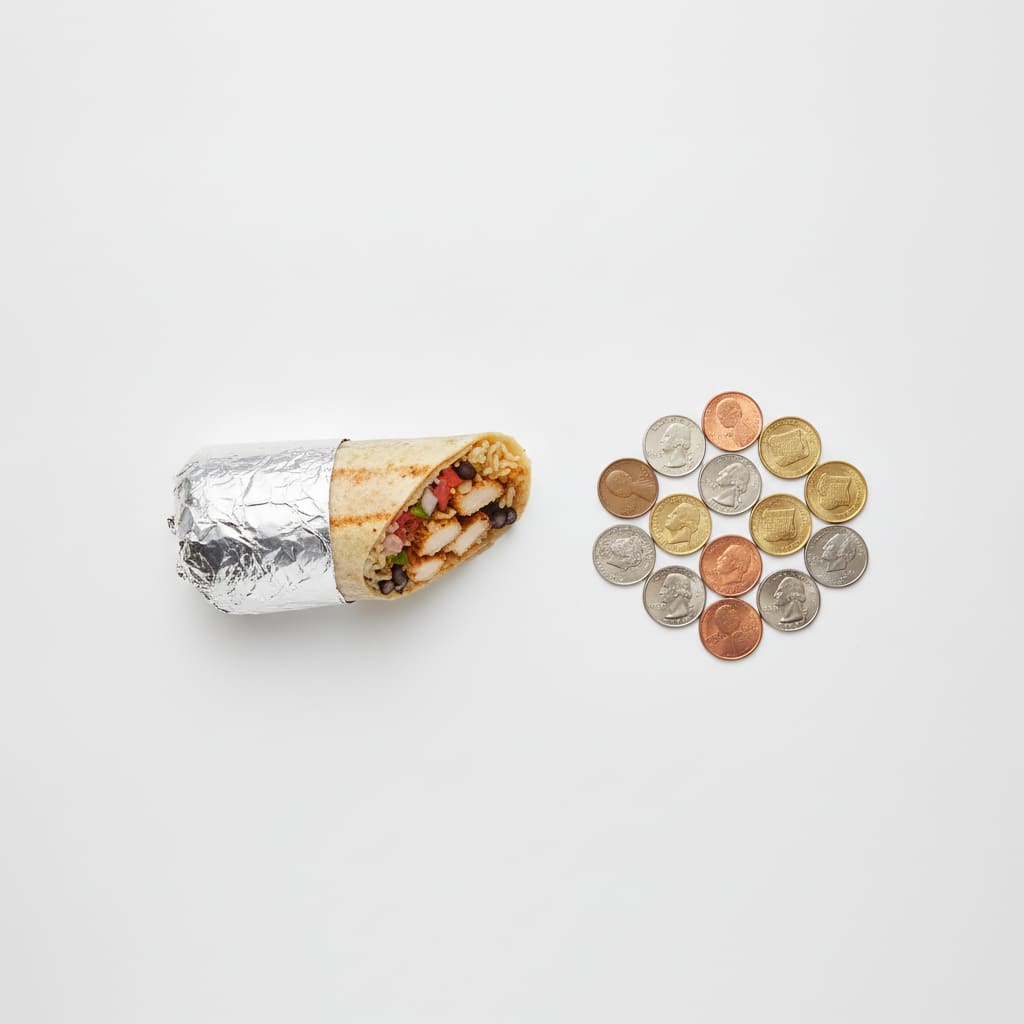
Every chain claims value. "Value" is a marketing word, so it means whatever the marketer needs it to mean this quarter. Calories per dollar is not a marketing word: it is a division problem, and it produces a ranking nobody can spin.
What tops the list
Consistent high performers across the analyses that have run this math:
- Costco's hot dog and soda at $1.50: the reigning champion by a wide margin, unchanged in price since the 1980s and effectively an internal subsidy rather than a menu item.
- Bean-and-rice burritos at Taco Bell, around 400 calories for roughly a dollar-something, and unusually filling for the size because beans and rice bring fiber and starch rather than air.
- McDonald's McChicken, about 360 calories at $1.69, historically better value per calorie than a Big Mac plus large fries.
- McDonald's cheeseburger, roughly 350 calories at a low base price, which keeps it near the top of most rankings.
- Wendy's Jr. Bacon Cheeseburger, about 370 calories under two dollars.
- Little Caesars Hot-N-Ready pizza: a slice of the 14-inch pepperoni runs about 280 calories, and the whole-pie price is what makes it a family-scale answer rather than an individual one.
Across menus, historical analysis has found McDonald's delivering more calories per dollar than KFC or Burger King, with a wider spread of items doing it.
Why the metric is worth knowing
Because it strips out the two things that distort every other comparison: brand and presentation. A combo that feels generous and an item that is dense are different claims, and only one of them survives division.
It is also the honest metric for a real constraint. For someone eating on a genuinely tight budget, calories per dollar is not a curiosity, it is the operative question: the difference between a full day and a hungry one.
Where it lies to you
This is the part most calories-per-dollar listicles skip, and it matters:
Calories are not nutrition. A tub of frosting wins this metric outright. Nothing about a high ranking implies the food is good for you, and optimizing hard for calories per dollar leads directly to a diet of refined carbohydrate and fryer oil.
Satiety is not linear with calories. 400 calories of bean burrito and 400 calories of soda produce completely different afternoons. Protein and fiber keep you full; liquid sugar does not. This is why the bean burrito outperforms its calorie count and a large soda badly underperforms its own.
The drink distorts the bundle. Combos rank well on calories per dollar largely because a fountain drink adds 150-300 calories at a marginal cost to the restaurant of a few cents. Those calories are real and they are also the least useful ones you will buy all day.
Prices are local. Franchisees set their own prices, so a national ranking is directional. The same item can shift a rank or two between two towns.
The better version of the question
Calories per dollar is a good first filter and a bad final answer. The version worth using is protein per dollar, or at minimum calories per dollar with a protein floor: it points at grilled chicken, beans, and eggs instead of a large fry, and it tracks how full you actually feel.
If you want to run it yourself, both halves are on the site: the menu prices for the same items, and the cheapest-menu rankings if you want the price side pre-sorted. The math is one division and it will change what you order.